AI ERP for manufacturing: how Syncrra Predict adds intelligence to the system you already have
Most Indian MSME manufacturers already have some kind of system in place, an ERP, or at least a mix of spreadsheets and accounting software holding their data. Ripping that out and starting over is expensive, disruptive, and rarely worth the risk.

Author
Nisha Mane
Published
Aug 31, 2026
Last updated
Aug 31, 2026
Most Indian MSME manufacturers already have some kind of system in place, an ERP, or at least a mix of spreadsheets and accounting software holding their data. Ripping that out and starting over is expensive, disruptive, and rarely worth the risk. Perhaps this is why [87 percent of Indian MSMEs expect AI to lift their productivity, but 91 percent say it only makes sense if it is affordable](https://www.pwc.in/assets/pdfs/unlocking-the-ai-edge-for-msmes.pdf), not something that demands a whole new system. But the data sitting inside those systems usually goes to waste. It sits there as a record of what already happened, instead of helping predict what happens next. This is the gap Syncrra Predict is built to close. It is not a separate ERP that replaces what you use today. It is an AI layer that sits on top of your existing system, reading the data you already have and turning it into forecasts and early warnings your team can act on. This post explains what an AI layer for manufacturing ERP actually means, what Syncrra Predict does with your existing data, and why adding intelligence on top of your ERP is a more practical path than replacing it.
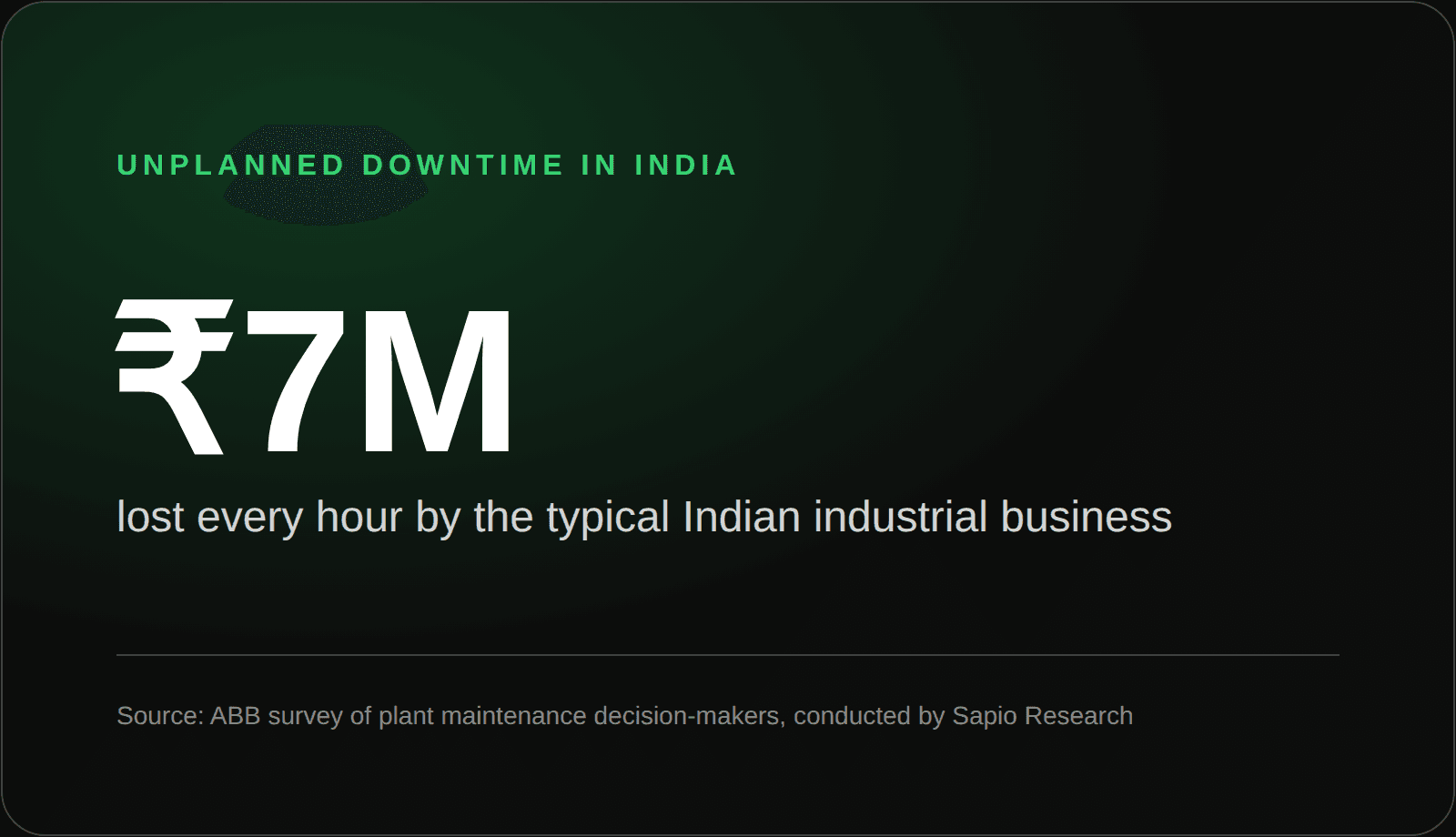
₹7 million is lost every hour to unplanned downtime by the typical Indian industrial business (ABB / Sapio Research) Why replacing your ERP is rarely the right answer
Switching ERP systems is one of the most disruptive changes a manufacturing business can make. It means re-entering years of data, retraining every team from the shop floor to accounts, and living with teething problems while the new system beds in. For a business running tight production schedules, that disruption has a real cost.
The numbers back this up. Research from the India SME Forum's Digishaastra META Report Card 2025 found that 52.6 percent of Indian MSMEs already find it difficult just to choose the right digital tools, and 36.8 percent find setting up and rolling out new tools challenging. The same report found that 46.2 percent of Indian MSMEs still operate fully offline, and even among those that have gone digital, only 13.2 percent actively use analytics tools.
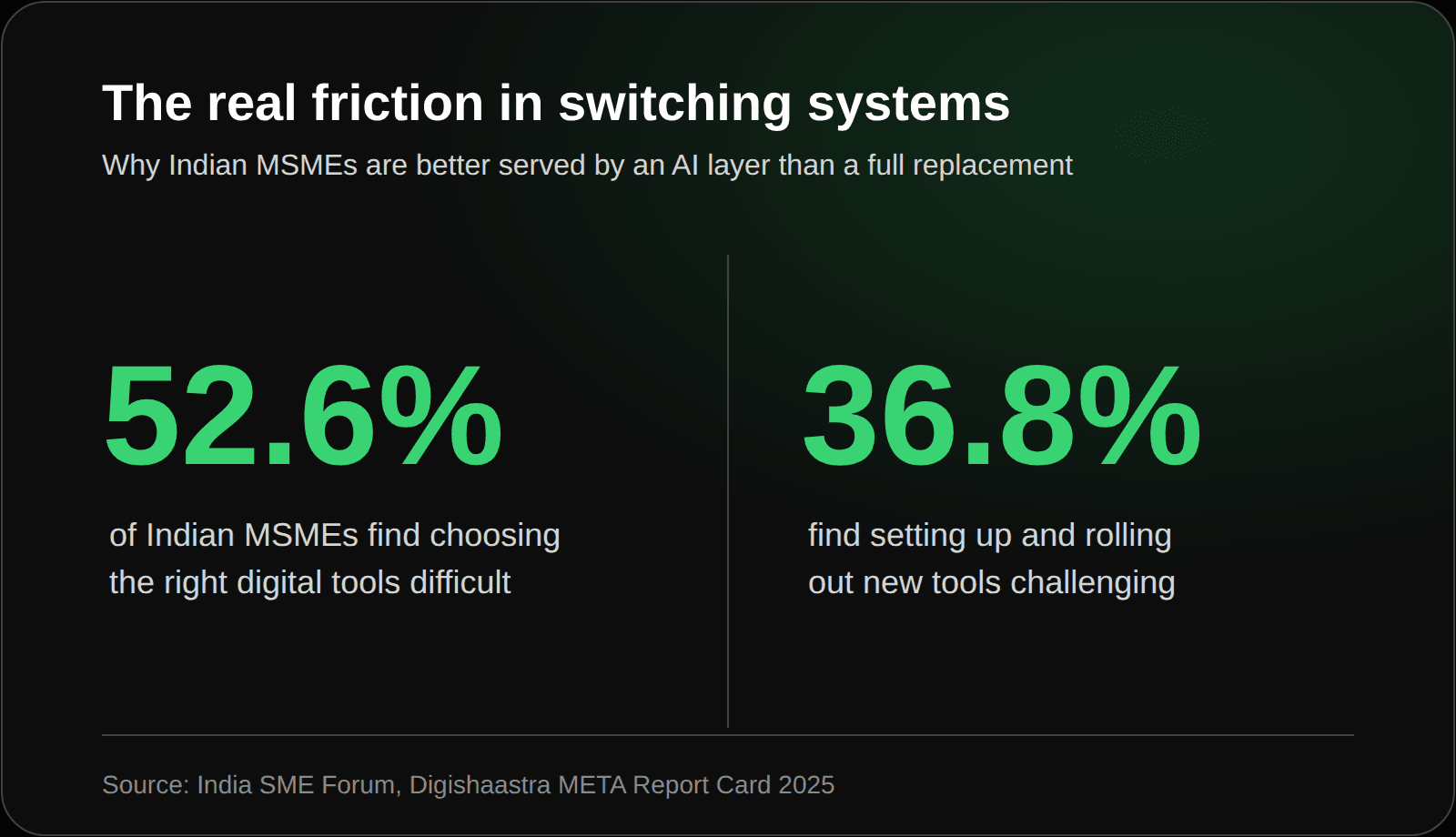
52.6% of Indian MSMEs find choosing the right digital tools difficult, 36.8% find rollout challenging (India SME Forum, 2025)
Many Indian MSME manufacturers stay on ageing or basic systems for exactly this reason, not because the system works well, but because switching feels riskier than staying put. This is a big part of why traditional manufacturing ERP systems fail at scale, the system itself does not grow with the business, but replacing it feels like more trouble than it is worth.
An AI layer takes a different approach. Instead of asking you to move away from your existing ERP, it works with the data already flowing through it.
What an AI layer for manufacturing ERP means
An AI layer sits on top of your existing operational data, whatever system it lives in, and applies predictive intelligence to it. It does not change how your team enters data or run a parallel process. It reads what is already there and looks for patterns your team would not have time to spot manually.
This is different from a traditional ERP module, which mostly records what has already happened. An AI layer looks forward. It flags a likely stock shortage before it happens, a demand spike before it hits, or a machine issue before it causes a breakdown.
Connects to the ERP you already run
Syncrra Predict is built to connect directly to SAP, Oracle, Tally, and other legacy ERP systems, not just Syncrra's own modules. It reads the data already sitting inside whatever system your factory runs today, so there is no need to move your records to a new platform first.
This matters because your team's day-to-day workflows stay exactly as they are. Purchase orders, production entries, and billing continue through the same system your people already know. AI-powered insights, forecasting, and automation are layered on top, working alongside your existing process rather than replacing it.
Because there is no rip-and-replace migration involved, rollout is faster too. A structured, phased setup connects Syncrra Predict to your existing ERP with minimal disruption to daily operations, so your team sees forecasts and early warnings within weeks, not after a long, risky system overhaul.
What Syncrra Predict actually does
Syncrra Predict brings four connected types of prediction to your existing manufacturing operations.
- Demand forecasting. It looks at order history and production patterns to anticipate demand shifts, so purchasing and planning are not always reacting to what already happened.
- Performance forecasting. It tracks how production lines and teams are trending, flagging when output is likely to fall short of target before the end of a shift or a week, not after.
- Revenue forecasting. By connecting production and dispatch data to billing, it gives a clearer, forward-looking view of expected revenue, rather than relying on a monthly close to see where the business stands.
- Anomaly and risk detection. It continuously watches for deviations, a machine trending towards failure, a quality pattern starting to slip, a supplier delivery running late, and flags these early, before they turn into a bigger problem.
This gap between exposure and preparation is wide across Indian industry. An ABB survey of plant maintenance decision-makers, conducted by Sapio Research, found that unplanned downtime costs the typical Indian industrial business close to INR 7 million an hour, with 88 percent of Indian industrial businesses facing unplanned outages at least once a month. Yet 19 percent still rely on run-to-fail maintenance, with no proactive plan at all.
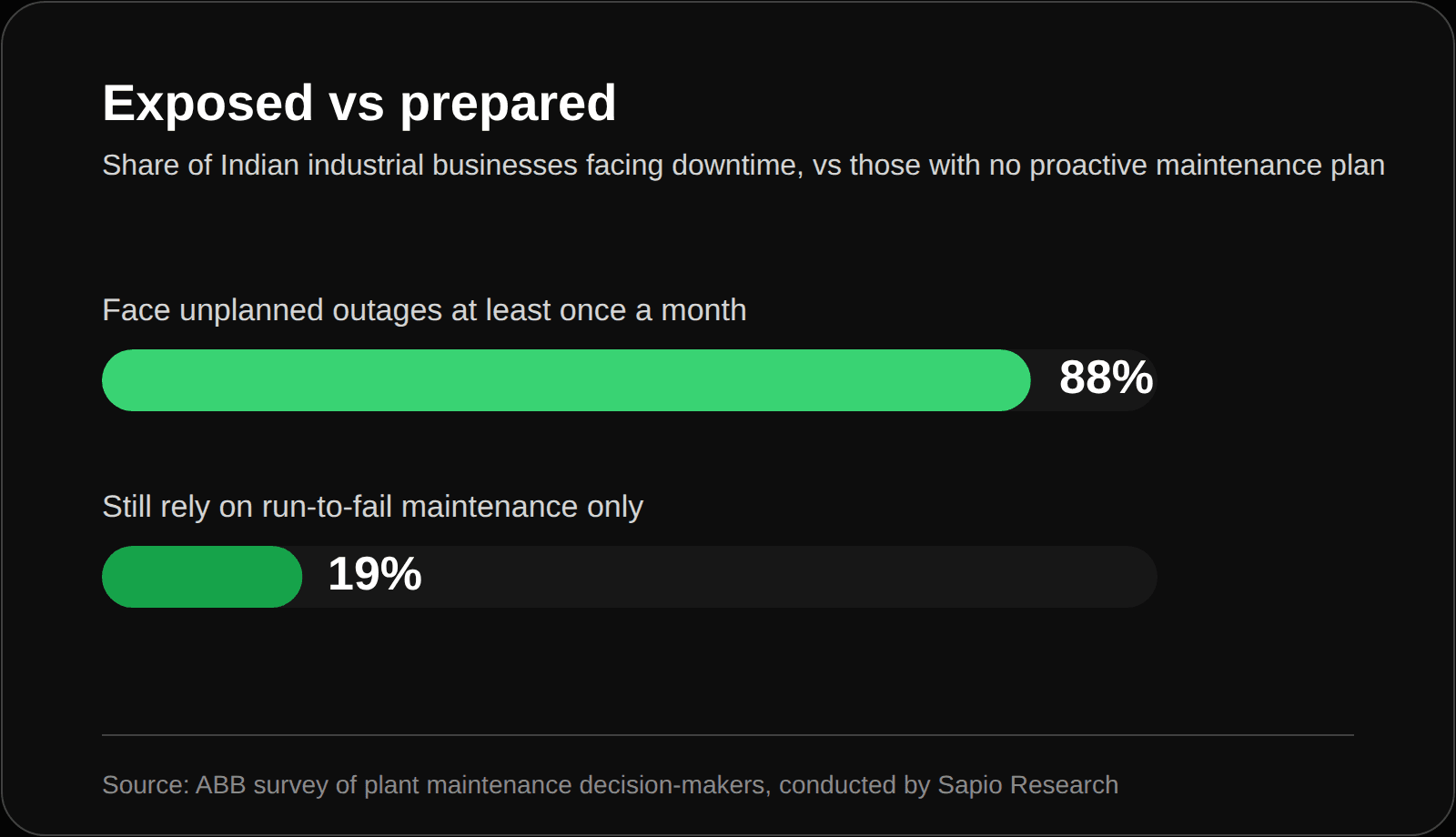
88% of Indian industrial businesses face unplanned outages at least once a month, 19% still rely on run-to-fail maintenance (ABB / Sapio Research)
This is the same continuous, always-on approach covered in our post on how agentic AI is reshaping manufacturing dashboards, where AI works in the background rather than waiting for someone to run a report.
Built on the data you already have
Syncrra Predict does not need a separate data entry process or new hardware to get started. It draws on the same production, inventory, quality, and dispatch data already moving through your operations, whether that data lives inside Syncrra's own modules or your existing ERP and connected systems.
This means the forecasts and alerts it produces are grounded in what is actually happening on your factory floor, not general industry assumptions. A demand forecast reflects your real order history. A machine risk alert reflects your real production data, not a generic maintenance schedule.
How this connects across your operations
Prediction is only useful if it reaches the right team in time to act on it. Syncrra Predict connects into production planning, so a demand forecast or flagged risk can shape scheduling directly. It connects into quality control, so a pattern in rejections can be traced back to its cause early. It also connects into dispatch and billing, so revenue forecasting reflects what is actually moving through your factory, not a separate estimate.
This kind of connected intelligence is at the centre of why Syncrra exists in the first place, one system giving every department the same forward-looking view, not isolated reports each team has to compile by hand.
What good looks like
- Forecasts and alerts built on your real operational data, not generic industry benchmarks
- No need to replace your existing ERP or re-enter historical data
- Risks and demand shifts flagged early enough for your team to actually act on them
- Predictions that connect directly to production planning, quality, and dispatch, not sitting in a separate report
- A system that gets more accurate over time as it learns from your factory's own patterns
One of our manufacturing clients saw this shift directly, moving from reactive decision-making to a system that flagged issues and shifts in demand before they became a problem on the floor.
See how it fits your operations
Syncrra Predict is one part of a wider platform built to make your existing systems smarter, not replace them. Explore the full set of AI capabilities on our features page, see how every module connects on our overview page, or read our complete guide to ERP for sheet metal factories for the bigger picture.
Frequently asked questions
What is an AI layer for manufacturing ERP?
It is AI that sits on top of your existing ERP and operational data, turning records of what has already happened into forecasts and early warnings, without requiring you to replace your current system.
Does Syncrra Predict replace our existing ERP?
No. It is built to work with the system you already have, reading your existing data rather than asking you to migrate to a new platform.
Which ERP systems does Syncrra Predict connect to?
It connects directly to SAP, Oracle, Tally, and other legacy ERP systems, as well as Syncrra's own modules, so it fits alongside whatever your factory already runs.
How long does it take to go live?
Because there is no rip-and-replace migration, rollout follows a structured, phased setup that connects to your existing ERP with minimal disruption, so most teams see forecasts and alerts within weeks rather than months.
What kinds of predictions does Syncrra Predict make?
It covers demand forecasting, performance forecasting, revenue forecasting, and anomaly or risk detection, including early warning signs of machine issues, quality drift, and supplier delays.
Do we need new hardware or sensors to use it?
No. It works from the production, inventory, quality, and dispatch data already flowing through your operations.
Is this only useful for large manufacturers?
It is but Indian MSME manufacturers often gain the most, since they usually have less spare capacity to absorb a surprise, whether that is a demand spike, a stock shortage, or a machine breakdown.
Make your existing ERP smarter
You do not need to replace what you already have to get ahead of demand shifts, machine issues, and production risk. See how Syncrra Predict fits on top of your current system, or try it free for 30 days.
Try Syncrra free for 30 days → See the features page →
Did you find this blog helpful? Share it with others who might benefit!
Loading link...
No previous post
Previous Blog PostDispatch and billing ERP: closing the gap between production and invoicing
Next Blog PostRelated Blogs
Dispatch and billing ERP: closing the gap between production and invoicing
An order can be finished, packed, and out the door, and still take days to turn into an invoice. In many sheet metal and fabrication businesses, dispatch and billing are handled as separate steps, often by different teams, with paperwork passed between them by hand.
 By Shrutika Tatkare
ERP for sheet metal factories: the complete guide
Running a sheet metal factory means juggling raw material stock, cutting and bending schedules, quality checks, and dispatch deadlines, often at the same time. Many factories still do this with a mix of Excel sheets, paper job cards, and WhatsApp updates. It works, until it doesn't.
 By Avantika Shende
Quality control ERP: how sheet metal factories can cut rejections and build traceability
A rejected batch is never just a quality problem. It is a delay, a cost, and often a difficult conversation with a customer. In sheet metal and fabrication work, where tolerances are tight and machines run continuously, small quality issues can slip through unnoticed until they become expensive ones.
 By Vinita Shimpi